In a twin-screw extruder, the screw is mainly divided into feeding section, melting section, mixing section, venting section and homogenizing section. The main functions of the screw elements are conveying, melting, shearing, material mixing, and residence time control. The screw elements of the twin-screw extruder are combined in a “building block” manner, which can be adjusted according to different production needs in practice. Therefore, the screw combination is the key to the customization of the twin-screw extrusion process.
The intermeshing co-rotating twin-screw extruder is mainly used for compounding. The screw combination should consider the properties and shapes of the main and auxiliary materials, the sequence and position of feeding, the position of the vent, the barrel temperature settings, etc. At the same time, the objects of mixing are very complex, and a reasonable screw combination needs to be made for each specific mixing process. Nevertheless, there are basic rules to follow in the screw combination of intermeshing co-rotating twin-screw extruders.
Here are some basic principles of screw combination.
1. A Large Lead Screw Element Should Be Used at the Feeding Port to Ensure Smooth Feeding.
The feeding section mentioned here refers not only to the screw section below the first main feeding port but also includes the screw section of the downstream feeding port. The main requirement for the feeding section is to be able to smoothly and adaptively add various materials, including granules of various shapes, low bulk density powders, fibrous additives, etc. This section generally uses large lead, right-angle thrust angle, forward thread (usually SK conveying) conveying elements.
With the screw groove depth remaining constant, a large lead implies a larger screw groove volume. For the feeding section below the first main feeding port, it can accommodate and add a large volume of materials. For the feeding section of the downstream feeding port, it can create a low fill level with the material transported from upstream to accommodate newly added materials.
Most twin-screw extruders use standard large lead screw elements with equal depth. Some also use non-standard screw elements with increased groove depth to achieve greater feeding and conveying capabilities. However, using non-standard screw elements with increased groove depth will inevitably sacrifice the thickness between the bottom diameter of the screw and the spline of the core shaft, resulting in thinner walls. This can lead to risks such as cracking of the feeding section components and shorter service life of the screw elements during production. Therefore, increasing the groove depth is generally not adopted in most cases.
2. In the melting section, small lead screw elements should be used first to build up pressure, thereby compressing and melting the material.
Kneading blocks with a staggered angle of 90° can be set to balance the pressure, or kneading blocks with a staggered angle of 30° can be used for preliminary distribution mixing of the material. Kneading blocks should be arranged starting from the middle of the melting section, and it is important to space them out evenly.
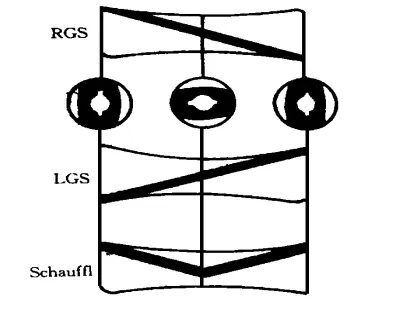
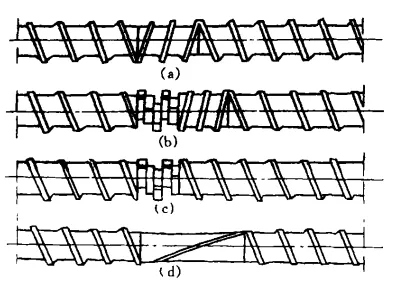
There are two sources of heat for melting the material: one is external heat provided by the barrel heater, and the other is shear heat introduced by the screw, with the latter being the main source. To introduce shear heat, kneading blocks, reverse thread elements, and non-standard rotor-type extruder screw elements (Figure 1) should be set in the melting and plasticizing section. These elements should be effectively combined with the upstream forward screw elements at predetermined axial positions on the screw, as shown in Figure 2.

RGS – Right-handed Grooved Screw
LGS- Left-handed Grooved Screw
Schauffl- Screw with alternating left and right flights
Figure 1 Rotor-Style Large Lead Screw Element

(a) Reverse screw element (b) Forward kneading block + reverse screw element
(c) Forward kneading block (d) Reverse asymmetric large lead screw element
Figure 2 Local Screw Combinations for Melting
The standard for evaluating the quality of a local screw combination in the melting and plasticizing section should be its ability to convert mechanical shear energy into thermal energy, thereby melting the material as quickly and thoroughly as possible without increasing the material temperature, i.e., the most reasonable use of energy.
Experiments have found that configuration b in Figure 2, under high-speed operation of the screw, melts the material quickly and has a very short melting zone. However, in this section and the upstream area, the temperature rise of the material is very high, far exceeding the original set temperature and the energy required for melting the material, and the melt pressure is also very high. This indicates that this screw combination dissipates too much mechanical energy, not only melting the material but also significantly increasing the melt temperature, which is clearly not optimal.
A better screw combination for melting is shown in Figure 2 as combination c. It allows most of the material to undergo controlled and constant shear and pressure, thus keeping the material temperature low.
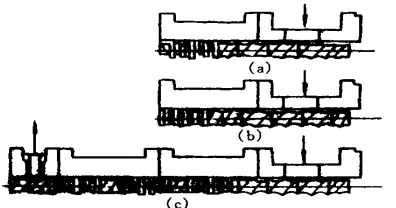
To avoid excessive temperature gradients in the melting and plasticizing section, shear elements and forward thread conveying elements can be interspersed, distributing the total energy input in a certain order over a specific axial length, as shown in Figure 3(c).

(a) Forward kneading block + reverse screw element (b) Reverse kneading block
(c) Forward kneading block and forward screw elements alternately arranged to the exhaust port
Figure 3 Screw Combinations for Melting Used by Granuwel Company
3. The primary purpose of the mixing section is to shear, refine, and disperse material particles.
The configuration of screw elements in this section is highly complex and requires designers to have extensive practical experience. In this section, kneading blocks with staggered angles of 45° and 60° are mainly used to enhance shearing, supplemented by special elements such as gear-shaped or “S”-shaped elements.
However, it is important to note that kneading and shearing elements should not be overused or arranged too closely together, to avoid excessive shearing. Additionally, to enhance the material conveying capability in this section, conveying elements should also be interspersed, meaning kneading blocks and conveying elements should be staggered.
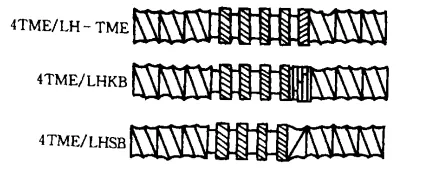
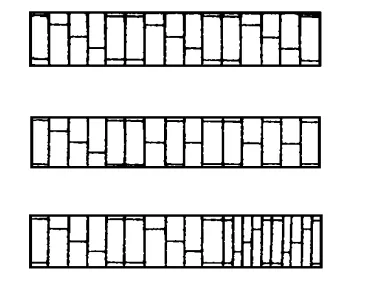
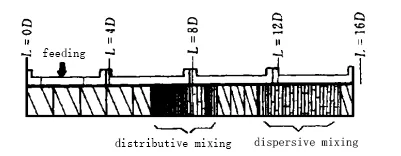
Figure 4 shows a screw configuration in the design of twin-screw combinations, consisting of gear-shaped elements and other elements that increase the intensity of distribution mixing. Figure 5 shows a combination suitable for increasing the intensity of melt mixing, composed of two-headed and three-headed kneading blocks. Figure 6 is a screw combination for distribution and dispersion mixing, consisting of kneading blocks and screw elements.

ME – Turbine Mixing Element; LH Left-handed;
KB – Kneading Block; SB – Single-flight Reverse Screw Element.
Figure 4: Screw Combinations for Enhanced Distributive Mixing Used by W&P Company

Figure 5: Mixing Section with Enhanced Mixing Intensity Composed of Two-Flight and Three-Flight Kneading Blocks

Figure 6: Screw Combination Composed of Kneading Blocks and Screw Elements for Distributive and Dispersive Mixing
Figure 4 shows a screw configuration in the design of twin-screw combinations, consisting of gear-shaped elements and other elements that increase the intensity of distribution mixing. Figure 5 shows a combination suitable for increasing the intensity of melt mixing, composed of two-headed and three-headed kneading blocks. Figure 6 is a screw combination for distribution and dispersion mixing, consisting of kneading blocks and screw elements.
4. Before the venting or vacuum port, reverse screw elements or reverse kneading blocks should be set.
At the venting or vacuum port, large lead screw elements should be set. After the venting or vacuum port, small lead screw elements should be set. This combination can allow the removal of volatile components in the material as much as possible.
The intermeshing co-rotating twin-screw extruder is equipped with a venting zone to remove moisture, entrained air, and volatile components from the material. Upstream of the venting port on the screw, sealing elements should be set to seal the melt and establish high pressure. In the venting zone, which is the screw section facing the venting port, the material should have a lower fill level in the screw grooves and be connected to the atmosphere or vacuum pump.
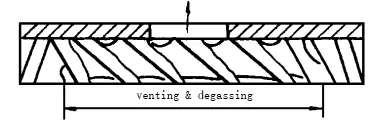
To seal the melt and establish high pressure, reverse screw elements or reverse kneading blocks can be used. In the venting zone, large lead screw elements should be adopted (Figure 7) to create a low fill level and thin melt layer, allowing the material to have a large exposed free surface and a long residence time, which facilitates venting.

Figure 7 Screw Combination in the Venting Zone
5. In the homogenization section, the screw lead should be gradually reduced to increase pressure and shorten the length of the back pressure section.
At the same time, single-headed screws and wide-flighted screws should be used to enhance discharge capability and avoid material overflow.
Finally, it should be noted that the screw combination of each functional section must be selected based on the specific mixing task (co-mixing modification or filler modification) and the requirements of the mixing process.
Nanjing Granuwel Machinery, through years of research and practice, has summarized the principles of screw combination for twin-screw extruders. This not only provides a valuable reference for the industry but also brings significant technological progress and market competitiveness to the company itself. We believe that with the widespread application and continuous optimization of these principles, the entire plastic processing industry will be driven towards more efficient and environmentally friendly development.