
The twin screw extrusion process is not just a method of processing materials—it is the key determinant in the quality and performance of the final product. Every step, from screw configuration to process control, directly influences the consistency, strength, and overall properties of extruded materials. This article delves into the aspects of twin screw extrusion that most affect the results, revealing the critical factors manufacturers must optimize to achieve superior outcomes.
What Is the Twin Screw Extrusion Process?
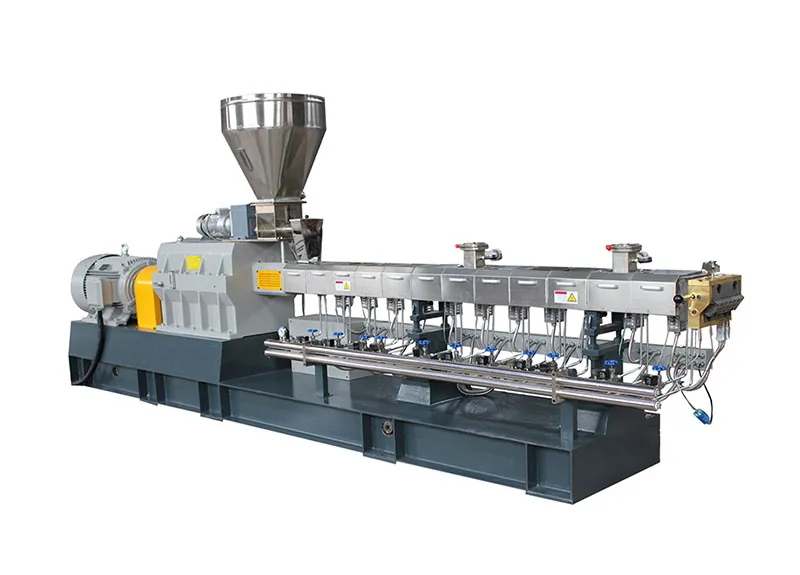
The twin screw extrusion process involves the use of two intermeshing or non-intermeshing screws rotating inside a cylindrical barrel to process materials. These screws facilitate continuous mixing, melting, and shaping of raw materials, making the process ideal for industries such as plastics, food, pharmaceuticals, and chemicals.
There are two main types of twin screw extruders:
1. Co-rotating twin screw extruders
Co-rotating twin-screw extruders feature intermeshing screws rotating in the same direction, enabling efficient material conveyance, intensive mixing, and self-cleaning action to reduce stagnation and degradation. Widely used in polymer processing, masterbatch production, and high-performance filler compounding, they ensure excellent melt homogenization, temperature control, and adaptability. Their modular screw and barrel design allows precise customization for various formulations, making them essential in advanced polymer engineering.
2. Counter-rotating twin screw extruders
Counter-rotating twin-screw extruders have screws that rotate in opposite directions, providing high compressive forces and superior melt uniformity. Ideal for shear-sensitive and thermally unstable materials like PVC, they offer controlled shear, precise temperature management, and enhanced feeding efficiency. This design is well-suited for profile extrusion, pipe manufacturing, and rigid PVC applications, delivering excellent devolatilization and consistent product quality.
Critical Factors Affecting the Results
The final quality of extruded products is most affected by several interrelated factors within the twin screw extrusion process. Understanding and controlling these elements is essential for achieving optimal results:
Screw Design and Configuration
The geometry of the screws—including their shape, length, pitch, and arrangement—is paramount. Screw types and geometries are critical and can be categorized into conveying elements and mixing/kneading elements. Conveying elements, which vary in parameters such as shape, length, and pitch, influence material transport efficiency and compression ratio. Mixing/kneading elements include kneading blocks and other specialized functional components. Parameters such as the angle and thickness of the kneading blocks determine their mixing capability and shear intensity. An effective design ensures proper material conveyance and mixing, controls shear forces, and impacts the residence time. Fine-tuning these parameters helps in achieving a uniform melt and, ultimately, a high-quality product.
Temperature Control
Temperature is one of the most sensitive parameters in the extrusion process. Precise control prevents the degradation of heat-sensitive materials while ensuring uniform melting. Even slight deviations can result in poor material flow or inconsistent physical properties in the final product.
Material Feed Rate and Composition
The balance between polymers, fillers, reinforcements, and additives determines how well the material blends during extrusion. A consistent feed rate coupled with an optimal material mix ensures that the extruder can maintain a stable process, reducing variability and enhancing the final product’s quality.
Screw Speed and Torque
The speed at which the screws rotate directly affects the shear applied to the material. While higher speeds can improve mixing and throughput, they can also introduce excessive shear heat. Managing screw torque is crucial to prevent overheating and to maintain the integrity of the material. Excessive torque (>80% of motor capacity) may indicate improper screw design or material viscosity mismatch, requiring dynamic adjustment.
Degassing Efficiency
The removal of volatile compounds and trapped gases is critical. Effective venting prevents the formation of bubbles and voids that could compromise the mechanical properties of the final product. This step ensures a cleaner, more uniform output.
Working Principles of Twin Screw Extrusion
The twin screw extrusion process operates through several stages:
- Feeding – Raw materials, including polymers, fillers, and additives, are fed into the extruder through a hopper.
- Conveying and Melting – The screws transport the materials forward, generating heat through shear forces and external heating elements.
- Mixing and Homogenization – The intermeshing screws ensure proper dispersion of additives and fillers, improving material consistency.
- Degassing – Volatile compounds and trapped gases are removed through venting zones to enhance product quality.
- Shaping and Cooling – The molten material is forced through a die to create the desired shape and is then cooled using water or air cooling systems.
Applications of Twin Screw Extrusion
The twin screw extrusion process finds applications across multiple industries due to its precision and flexibility. Some of the most common uses include:
- Plastics and Polymer Processing – Twin screw extruders are widely used in the compounding of thermoplastics, reinforcing fillers, and polymer blends.
- Food Industry – Used for the production of pasta, breakfast cereals, snack foods, and pet food, where controlled processing ensures consistent texture and quality.
- Pharmaceuticals – Employed in the production of controlled-release drugs, granulation, and tablet formulations.
- Chemical Industry – Ideal for the continuous mixing of chemical compounds, adhesives, and sealants.
- Pet Food Compounding and Pelletizing – Ensures uniform nutrient distribution and optimal pellet density for animal feed.
- Glue Compounding – Enables precise viscosity control and homogeneous mixing of adhesives.
- Gunpowder Compounding – Facilitates safe and consistent blending of energetic materials.
- Special Chemical Fiber Processing – Used for homogenization, de-bubbling, and filtering extrusion in synthetic fiber production.
- Bitumen Material Compounding and Extrusion – Enhances the modification and stability of asphalt binders for construction.
- Special Lubricant Reaction Compounding – Achieves tailored lubricant properties through controlled chemical reactions.
- Plastic Additive Compounding and Pelletizing – Ensures even dispersion of additives (e.g., flame retardants, UV stabilizers) in masterbatches.
How These Factors Contribute to Superior Results:
By closely monitoring and optimizing each of the above factors, manufacturers can dramatically improve the performance and consistency of their products:
- Uniform Material Flow: Customizing screw elements leads to improved melt uniformity, reducing defects and ensuring consistent product quality.
- Optimized Energy Efficiency: Controlling processing temperature and torque minimizes energy waste while maintaining the necessary conditions for high-quality extrusion.
- Enhanced Throughput: Balancing feed rate with screw speed ensures maximum production without sacrificing quality.
- Improved Thermal and Shear Management: Proper control of shear forces and residence time prevents degradation of heat- or shear-sensitive materials (e.g., PVC, bio-based polymers). Optimizing shear rates also improves filler dispersion, enhancing final product properties.
- Effective Degassing and Devolatilization: Well-designed venting zones remove trapped gases and volatiles, preventing defects like bubbles or weak spots. Efficient degassing ensures material consistency and strength, critical for applications such as pipeline extrusion where structural integrity is vital.
Conclusion
The twin screw extrusion process is a key factor in achieving high-quality results across various industries. By optimizing processing conditions, screw configurations, and material inputs, manufacturers can significantly improve product performance and efficiency. Among the many influencing factors, screw design, processing temperature, material composition, and degassing efficiency play the most critical roles. Whether for polymer compounding, food processing, or pharmaceuticals, understanding the factors that most affect the results ensures better control and consistency in production.
For those seeking a reliable and professional twin screw extruder manufacturer, we highly recommend checking out Granuwel. Granuwel is recognized for its expertise in designing and manufacturing high-quality twin screw extruders that meet rigorous industry standards.