
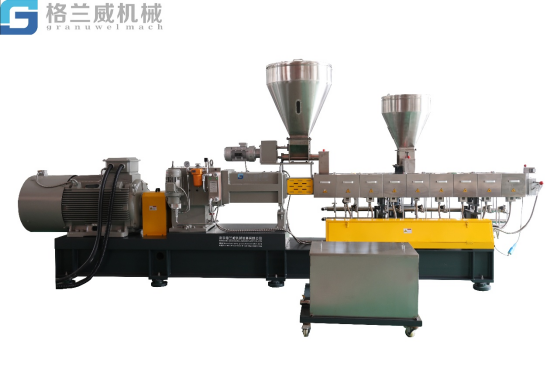
The mechanical properties of carbon fiber-reinforced plastics (CFRP) heavily depend on fiber length, but traditional processing methods often cause excessive fiber breakage, compromising strength. How can we achieve efficient mixing while minimizing fiber damage? Nanjing Granuwel Machinery’s co-rotating twin-screw extrusion technology offers an industry-leading solution.
Industry Challenge: The Fiber Length vs. Processing Damage Dilemma
For carbon fiber-reinforced engineering plastics (e.g., PA, PC, PEEK), strength, stiffness, and impact resistance are directly linked to fiber length. Research shows:
Fiber length > 0.5mm improves impact strength by 30%+;
However, high shear forces in traditional extruders often reduce fiber length to < 0.3mm, significantly weakening performance.
Key Challenge: How to ensure complete melting and dispersion while preserving fiber length?
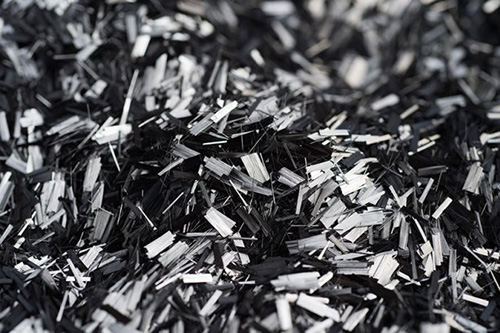
Equipment Optimization: How to Reduce Fiber Breakage?
1. Screw Configuration (Low Shear + High Dispersion)
Nanjing Granuwel’s GTE Series Twin-Screw Extruders feature modular screw designs for precise shear and dispersion control, critical for preserving fiber aspect ratio (L/D) and mechanical properties.:
- Reduce High-Shear Kneading Blocks → Minimize fiber damage by replacing 90° staggered kneading blocks with low-shear 30°–45° elements, lowering peak shear rates;
- Add Gentle Distributive Mixing Elements → Elements like wide-pitch screw flights (e.g., 60 mm pitch) or toothed mixing segments improve melt uniformity without excessive fiber attrition;
- Optimize L/D Ratio (40–48) → A longer barrel provides gradual melting & reduced localized shear, preventing fiber fracture in high-stress zones (e.g., near melting sections).
2. Side Feeder Positioning (Minimizing Fiber Wear)
Downstream Fiber Injection (Zones 5–6) → Delaying fiber introduction avoids prolonged exposure to high-shear melting zones, reducing mechanical degradation.;

Gravimetric Feeding Systems (Optional) → Ensures consistent fiber feed rates, preventing over-compaction or pre-breakage in hoppers/feed throats.

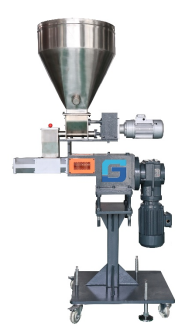
3. Triple-Screw Extruder (Advanced Multi-Shear Dispersion)
For demanding applications requiring ultra-high fiber loading (40%+ carbon fiber, glass fiber, or other advanced reinforcements) in high-temperature polymers (e.g., PEEK, PEKK, PPS), Nanjing Granuwel’s GSE-T Triple-Screw Extruder provides superior dispersion while minimizing fiber damage.
Key Advantages:
Dual Meshing Zones for Optimized Shear Distribution
- Unlike conventional twin-screw extruders, the triple-screw design features two intermeshing regions, distributing shear forces more evenly.
- Reduces peak shear stress by up to 30% compared to twin-screw systems, preserving fiber length and aspect ratio.
- 20% longer fiber retention → Critical for maintaining mechanical strength in structural composites.
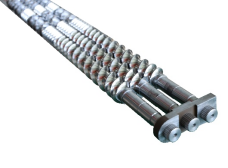
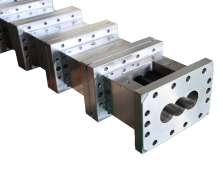
Triple-screw and barrel
- Precision Temperature Control for High-Temp Polymers
- Multi-zone heating with PID closed-loop control ensures ±1°C stability, essential for processing PEEK (up to 400°C+) and other high-performance thermoplastics.
- Independent barrel cooling prevents overheating in high-shear zones, reducing thermal degradation of fibers and matrix.
- Enhanced Fiber Wet-Out & Dispersion
- Staggered screw flights and asymmetric screw speeds improve polymer-fiber interaction without excessive breakage.
- Ideal for aerospace, automotive, and medical-grade composites where fiber integrity is critical.
Why Triple-Screw for High Fiber Loadings?
- The additional screw creates more controlled flow paths, reducing localized high-shear points where fibers typically fracture.
- Better stress distribution allows for higher filler content without sacrificing composite performance.
Applications:
- Carbon fiber-reinforced PEEK (CF/PEEK) for lightweight, high-strength components.
- Glass fiber-reinforced PPS (GF/PPS) for chemical-resistant industrial parts.
- Ultra-high-loading composites where traditional extruders struggle with dispersion and fiber damage.
Process Key: Temperature Zoning & Stability
Different matrix resins require precise thermal profiles to **prevent fiber degradation:
| Material | Processing Temp. (°C) | Critical Control |
| PA6/PA66 | 240~280 | Avoid localized overheating → Fiber oxidation |
| PC | 280~320 | Low speed + high torque → Reduce friction heat |
| PEEK | 380~420 | High-temp stability + N₂ purging (optional) |
Granuwel extruders feature PID temperature control (±1°C accuracy) for uniform melt.
Longer Fibers = Stronger Materials
In CFRP processing, equipment choice dictates performance:
– High-shear traditional extruders → Fiber breakage → Weaker parts;
– Granuwel’s optimized screws + precision control → Longer fibers → Higher strength/stiffness.
For carbon fiber-reinforced plastics (PA/PC/PEEK), preserving fiber length is key to maximizing strength. Nanjing Granuwel’s optimized twin-screw and triple-screw extruders deliver superior dispersion while minimizing fiber breakage. Need to process carbon fiber composites? Contact our experts for tailored solutions.